CREDIT PROGRAM
The financing cost your debt stack doesn't show
Team Gynger

The financing cost your debt stack doesn't show
A GPU provider can have billions of dollars in committed debt facilities and still send a customer elsewhere when that customer needs financing. The company has access to institutional capital at scale, yet a buyer that wants its product may still struggle to get the payment terms it needs.
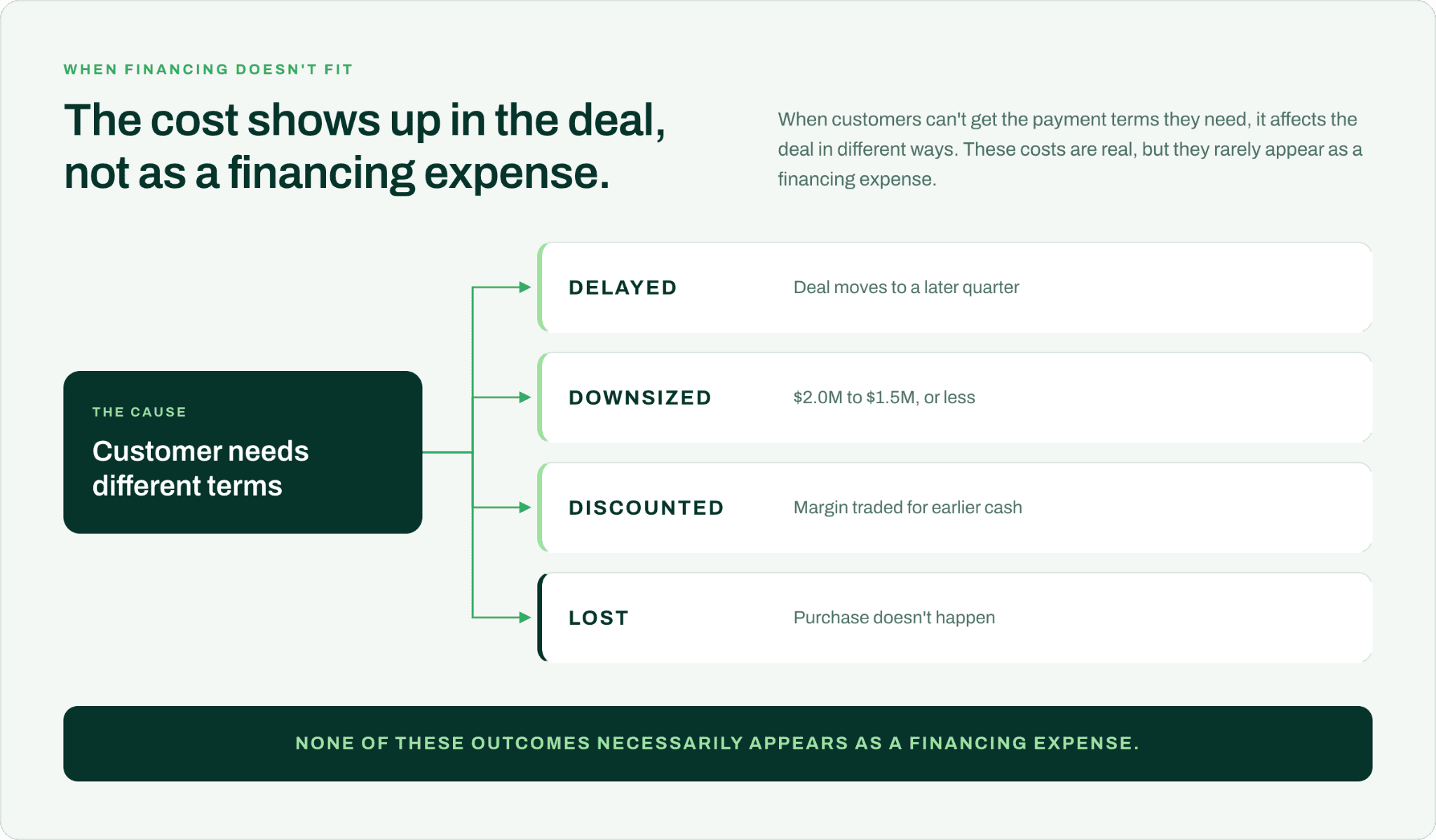
That gap can be expensive. It shows up in deals delayed over terms, contracts cut down to fit a budget, discounts offered to accelerate payment, and purchases that never happen. None of those outcomes is likely to appear as financing expense.
Funding the business and financing the customer are related, but they are not the same financial problem. For technology vendors with a varied customer base, treating them separately can expose a cost that is otherwise easy to miss.
In this piece, we look at where corporate funding stops, where customer financing begins, and why the gap between the two can matter commercially.
Funding the company and funding the purchase
Corporate funding asks whether you are good for the money. Customer financing asks whether this customer, buying this amount, on these terms is good for the money.
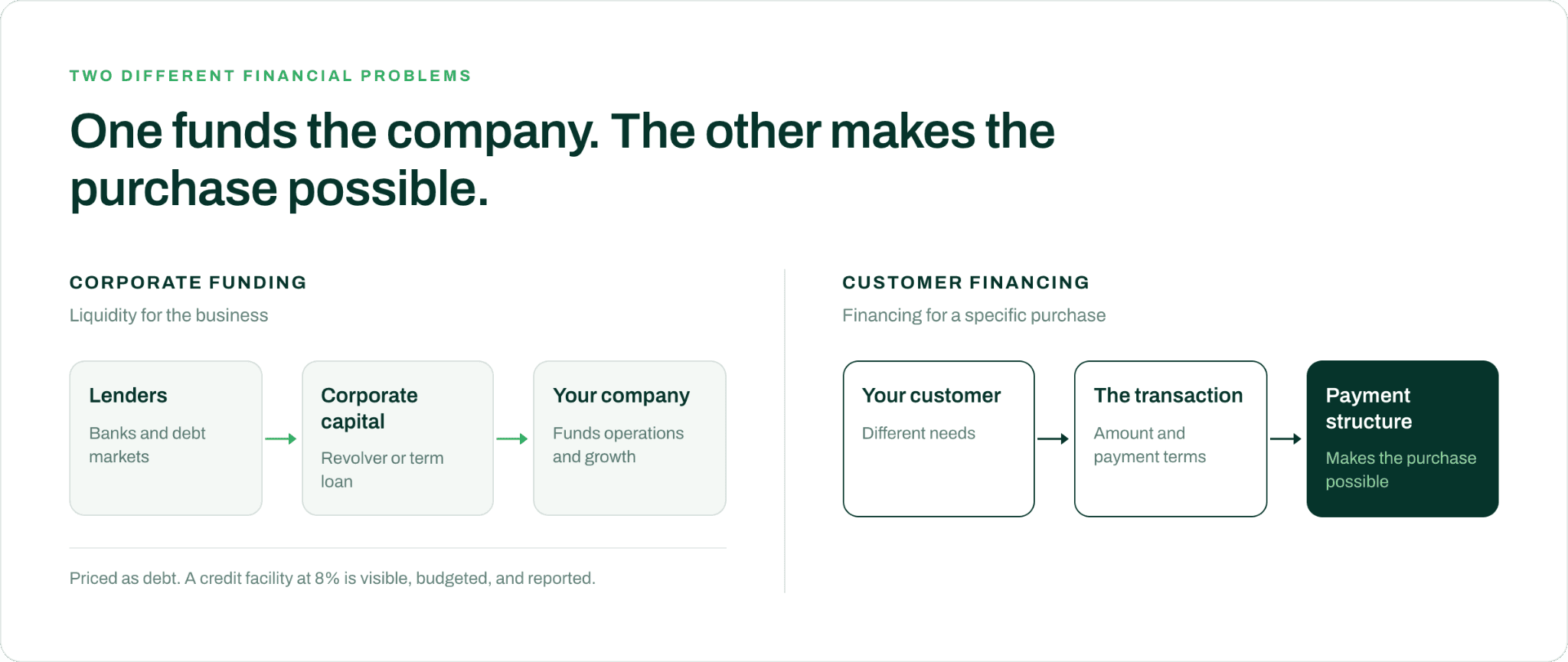
Corporate facilities are structured around the vendor: its balance sheet, cash flows, assets, leverage and ability to repay. Customer financing starts with the buyer and the transaction. There is overlap between the two. Customer quality matters in receivables-backed lending, for example, and concentration or eligibility rules can affect borrowing capacity. The Office of the Comptroller of the Currency notes in its Asset-Based Lending handbook that receivable eligibility varies with factors including collateral quality, borrower condition, industry and the bank's risk appetite.
But the financing is still solving a different problem. A revolver or term loan gives the company liquidity. An asset-based facility creates borrowing capacity against eligible assets. Factoring accelerates cash once a receivable exists. Prepay discounts pull cash forward by giving up some margin in exchange for earlier payment.
These tools can work well for the jobs they were designed to do. The distinction is that they are not primarily designed around the financing requirement of an individual customer while a sale is being made.
A well-financed company can therefore still have a financing problem at the point of purchase.
The cost shows up somewhere else
If a company pays 8% on a credit facility, the cost is explicit. If a $2 million opportunity becomes a $1.5 million contract because the customer cannot get acceptable payment terms, the economic effect is just as real, but it is unlikely to be recorded as a financing cost.
Instead, it sits in the CRM as a delayed opportunity, in pricing as a smaller contract, or in margin as a discount given to accelerate payment. Sometimes there is nothing to record because the purchase does not happen at all.
That makes the effect difficult to see in aggregate. Sales sees one part of it, pricing another, treasury another. A company can know its cost of debt to the basis point and still have a much less complete view of what its customer-financing constraints are costing commercially.
The more useful question is not only what the company's capital costs. It is what happens to revenue, margin and deal velocity when the financing available to customers does not fit the purchase.
The risk sits at the customer and transaction level
Consider two buyers of the same product. One is a Fortune 500 company asking for sixty-day terms. The other is a two-year-old venture-backed business with substantial cash, strong institutional investors and very little operating history.
They are not equivalent credit exposures, and they may not need the same payment structure. The vendor's internal credit process may already distinguish between them, and an asset-based lender may treat their receivables differently too.
The financing requirement, however, still exists at the level of the buyer, the purchase and the terms of that purchase. Supporting those terms from general corporate liquidity also has a cost: the same capital may be needed for infrastructure, inventory, acquisitions, growth or other priorities.
Customer terms are therefore a capital-allocation decision, whether the business explicitly treats them as one or not.
The opportunity is the deal the current model cannot support
This is where the economics become more interesting than a simple comparison of funding rates.
If the vendor has a lower cost of capital than its customer, there may be value in that spread. But the larger opportunity is often the transaction that does not fit the existing financing setup in the first place.
A younger company may have substantial cash and credible backers but too little operating history for a conventional credit model. Another buyer may be able to support the full purchase over twelve months but not upfront. A deal may be cut down because the available payment structure does not fit the customer's budget, or pushed into another quarter while financing is arranged elsewhere.
Hewlett Packard Enterprise encountered this when selling AI infrastructure to venture-backed companies. Derek Howard, PRSP Lead at HPE, said conventional criteria “simply didn't account for venture-backed growth companies that had limited operating histories but also significant market potential.”
For the vendor, the value of customer financing is broader than the spread between two funding rates. It affects the range of transactions the business is able to support.
What changes with a dedicated credit program
A dedicated credit program treats customer financing as its own problem rather than simply another demand on corporate liquidity.
The program can be built around the customer base, with buyers and transactions assessed at the level where the financing need exists. Financing capacity is there specifically to support customer purchases, and the structure can reflect how those customers buy.
That makes it possible to separate two questions that are often bundled together: how the company funds itself, and how its customers fund their purchases.
The point is not simply to find another source of capital. It is to build a credit program for a different job.
This will not matter equally to every vendor. If existing funding and credit processes already support the terms customers need, and financing rarely affects deal size, timing or conversion, there may be little additional problem to solve. It becomes more relevant when customer demand regularly extends beyond what the existing setup can support.
Where Gynger fits
Gynger lets technology vendors launch a credit program built around their customer base, under their own brand and aligned with the way they sell.
Gynger provides the capital and infrastructure behind the program, so vendors can offer financing without building a lending operation internally. The customer relationship stays with the vendor, which can also participate in the financing revenue the program generates.
The number worth looking at
A useful place to start is the last four quarters. How many deals were delayed because customers could not get the terms they needed? How many were downsized? How many disappeared altogether? And how much margin was given away through discounts whose real purpose was to get cash in sooner?
Those numbers may already exist in different parts of the business. Bringing them together creates a different view of the economics.
Most vendors know their cost of debt. Far fewer know the cost of the customer financing they don't have.
Considering putting your own capital to work?
See what that capital could earn in a customer credit program.
Run the numbers →
Join our newsletter to get monthly insights and updates
Next up


FAQ
What is a credit program?
It's the option for your customers to pay over time, offered under your own brand. You get paid upfront, your customer pays in installments, and Gynger runs the financing behind it.