Accounts Receivable
Accounts Receivable Automation for Technology Companies: Complete Guide
by
Team Gynger
•

Tech companies today are under constant pressure to scale rapidly while investing in high-cost infrastructure, SaaS platforms, and other mission-critical technologies. Whether it's onboarding new analytics tools, deploying security systems, or upgrading cloud infrastructure, the costs of these investments can put significant strain on a company’s working capital.
Strong cash flow is essential for these companies to remain competitive, fund innovation, and react quickly to market opportunities. However, managing cash flow is a complex task, especially when payments from customers are delayed, and internal finance processes are still relying on manual operations.
This is where accounts receivable automation becomes crucial. Accounts receivable automation can dramatically improve the speed, accuracy, and predictability of incoming cash. When integrated with smart payment solutions that offer customers multiple ways to complete large technology transactions, companies can streamline the payment process and improve cash flow timing.
What is Accounts Receivable Automation?
Accounts receivable automation refers to the use of software tools to streamline and automate the processes involved in billing, collections, and reconciliation. Instead of relying on manual systems like spreadsheets, email reminders, and paper-based invoices, accounts receivable automation tools automate the entire receivables lifecycle.
Key capabilities of AR Automation platforms include:
Automated invoice generation and delivery
Payment facilitation with flexible financing options
Customer prequalification and credit assessment
Scheduled and intelligent follow-up reminders for outstanding payments
Integration with accounting and ERP systems for real-time visibility
Dashboards that track aging reports, DSO (Days Sales Outstanding), and other KPIs
Payment predictions and risk scoring
Revenue acceleration through upfront payment collection
By automating these processes, businesses can reduce human error, improve cash forecasting, and shorten the time it takes to collect payments. For finance teams, this means more predictable cash flow, reduced overhead, and increased efficiency and time saved.
While traditional accounts receivable automation focuses on invoice reminders and collection follow-ups, modern AR automation solutions increasingly integrate with payment platforms that offer customer financing. This approach transforms the collection process entirely; instead of chasing payments from customers, technology sellers receive immediate payment while their customers access flexible financing options.
The Problem: Why Manual Receivables Hurt Growing Companies
Manual receivables management is a significant pain point for many mid-market and enterprise tech companies. You often extend payment terms to your customers, resulting in long cash conversion cycles. Without automation, your finance team may spend countless hours chasing invoices, reconciling payments, and managing aging reports manually.
Some of the common issues include:
Delayed collections: Payments are often received 30, 60, or even 90+ days after invoicing.
Resource strain: Internal finance teams are bogged down by repetitive tasks, reducing time for strategic planning.
Inaccurate forecasting: Manual tracking leads to unreliable cash flow projections, making it difficult to plan large tech investments.
Customer friction: Inconsistent follow-ups and a lack of payment options can frustrate clients and hurt relationships.
For example, a SaaS company closing multiple large B2B contracts may find itself cash-strapped while waiting for incoming payments, even though the business is growing. Without reliable receivables processes, investing in necessary technology upgrades becomes financially risky.
Benefits of Accounts Receivable Automation

Accounts receivable automation directly addresses the inefficiencies and risks of manual processes:
Accelerated Cash Collection: Automated invoicing and follow-ups ensure customers receive timely reminders. Some systems and strategies enable early payment discounts, reducing friction and delays.
Improved Accuracy and Compliance: Automation reduces errors in invoice creation and helps maintain compliance with accounting standards and contractual terms.
Better Cash Forecasting: Real-time dashboards and analytics provide finance leaders with visibility into expected inflows, allowing for more accurate cash planning.
Reduced Operational Overhead: Automation frees up internal teams to focus on higher-value tasks like financial strategy, budgeting, and scenario planning.
Enhanced Customer Experience: Clear, automated communications, multiple payment options, and self-service portals improve the payment experience for clients.
Why Accounts Receivable Automation Matters to Technology Buyers (Not Just Sellers)
For many companies, one of the most persistent challenges is timing. You may have a strong sales pipeline and a backlog of multi-year contracts, but if cash is tied up in receivables, those commitments can’t be deployed to fund growth. Revenue may look impressive on the income statement, yet liquidity on the balance sheet tells a very different story.
This is the core tension: companies often have significant contractual revenue but lack the cash availability to reinvest in their own infrastructure. Customer repayment schedules that stretch 12, 24, or even 36 months lock up significant working capital. The result is a mismatch between booked revenue and actual liquidity, forcing finance leaders to choose between delaying investments or layering on external financing at a higher cost of capital.
Accounts receivable automation changes this dynamic by providing:
Predictability: Understanding when and how much cash is coming in allows for better purchasing decisions.
Confidence: With consistent receivables performance, finance leaders can commit to larger investments with less risk.
Control: Automating collections provides a more disciplined and scalable approach to managing working capital.
The result? Accounts receivable automation transforms technology purchasing from a reactive, cash-constrained process into a strategic advantage. It enables you to invest in growth-driving technology when opportunities arise.
Where Gynger Complements Accounts Receivable Automation for Technology Buyers
Gynger's payment platform complements accounts receivable automation by addressing the payment timing challenge at its source. Rather than automating collection reminders, Gynger enables technology companies to offer prequalified financing to customers, resulting in immediate payment to the seller.
Here's how this comprehensive approach works:
Customer prequalification: Prospects can access financing options during the sales process, removing payment barriers
Immediate vendor payment: Technology companies receive payment upfront, eliminating receivables risk and collection delays
Flexible customer terms: Buyers get manageable payment schedules without impacting seller cash flow
Enhanced sales velocity: The combination of predictable AR processes and financing options converts more deals into immediate revenue
The result is a comprehensive cash flow optimization strategy that maximizes both collection efficiency from existing customers and deal acceleration for new prospects.
Key Considerations When Choosing an Accounts Receivable Automation Solution
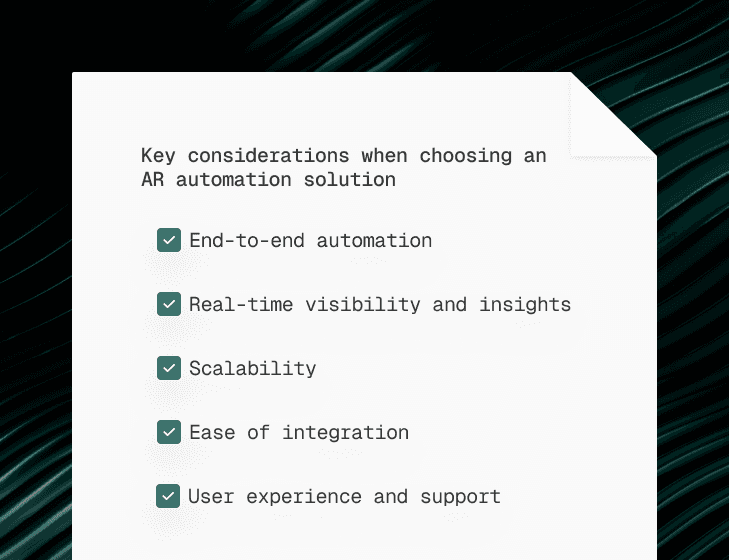
When evaluating accounts receivable automation platforms, it’s important for finance teams to consider how the solution fits into their broader financial operations and growth strategy.
Here are key factors to look for:
End-to-End Automation: Choose platforms that automate invoicing, reminders, reconciliation, and reporting without requiring extensive manual intervention.
Real-Time Visibility and Insights: Look for tools that offer intuitive dashboards and analytics so finance teams can track performance and make data-driven decisions.
Scalability: As your business grows, your receivables volume will increase. Choose a system that can scale with your operations.
Ease of Integration: The tool should fit seamlessly with your existing finance stack, from ERP systems to CRM platforms, to avoid siloed data and duplicate work.
User Experience and Support: Prioritize platforms with intuitive interfaces and responsive customer service, ensuring easy adoption and minimal disruption.
By focusing on these considerations, tech companies can choose an AR automation platform that not only improves collections but also becomes a long-term asset in their financial infrastructure.
Building a Cash-Optimized Tech Stack

For mid-market and enterprise companies, cash optimization isn’t about cutting corners; it’s about building smarter systems that enable strategic flexibility. A cash-optimized finance stack includes:
Accounts Receivable Automation tools to accelerate inflows and improve forecasting
Flexible financing solutions to smooth large or lumpy outflows
Data platforms for real-time visibility into KPIs like DSO, burn rate, and cash runway
This kind of stack allows finance leaders to act more like growth enablers and less like cash flow managers. When AR automation and customer payment solutions work together, companies can:
Accelerate receivables collection while removing customer payment friction
Maintain predictable cash inflows without sacrificing deal velocity
Make strategic technology investments based on reliable AR performance rather than waiting for customer payments to clear
Accounts Receivable Automation + Strategic Financing = Smarter Growth
Accounts receivable automation is no longer a "nice-to-have" back-office upgrade. For technology sellers, it's a foundational capability that ensures faster cash conversion, tighter control over working capital, and predictable revenue timing that enables confident business decisions.
By leveraging an accounts receivable management and payment platform like Gynger, companies unlock a comprehensive revenue optimization strategy. This accelerates collections on one side while removing payment barriers for new customers on the other.
In a market where cash flow predictability drives growth opportunities, integrating AR automation with smart customer payment solutions gives technology companies the dual advantage of faster collection cycles and higher deal conversion rates.
Join our newsletter to get monthly insights and updates
Next up


FAQ
Frequently Asked Questions
What is a credit program?
It's the option for your customers to pay over time, offered under your own brand. You get paid upfront, your customer pays in installments, and Gynger runs the financing behind it.