Accounts Receivable
A CFO's Guide to Accounts Receivable Best Practices
by
Team Gynger
•
Accounts receivable (AR) is far more than a routine finance function for CFOs. It plays a central role in managing liquidity, supporting growth, and maintaining financial resilience. Well-structured accounts receivable practices can shorten the cash conversion cycle, improve forecasting accuracy, and enhance balance sheet strength. Conversely, weak accounts receivable processes can limit flexibility and slow down strategic initiatives.
This guide explores how you can embed accounts receivable best practices into a broader capital management strategy, ensuring AR is managed not just efficiently, but strategically.
Laying the Groundwork: Credit Discipline and Payment Policies
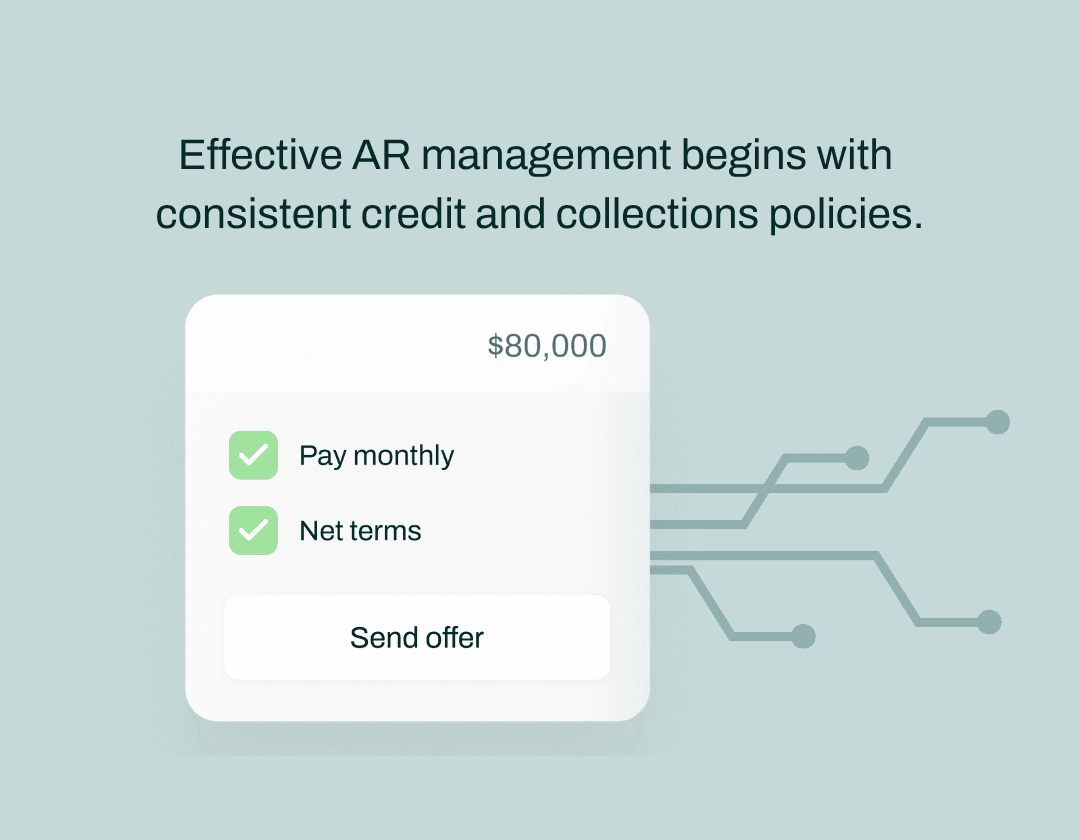
The foundation of effective accounts receivable (AR) management begins with well-defined, consistently applied credit and collections policies. Developing strong policies on these two aspects provide fundamental drivers of organizational liquidity, capital efficiency, and financial discipline. Policies set the tone for how a company manages risk, engages customers, and ensures predictability in cash flow.
Standardized Payment Terms: Payment terms should be both transparent and enforceable. Using precise, standardized terms like “Net 30” or “Due on Receipt” establishes clear expectations. Consistent application across all customers signals professionalism, reliability, and fairness.
Enforcement and Smart Compliance: Automated reminders, smart invoicing systems, and integrated compliance workflows can significantly reduce manual intervention and human error. These systems ensure that payments are tracked, follow-ups are consistent, and compliance is maintained effortlessly. Automation also provides valuable analytics on payment behavior, helping identify risk patterns earlier and making AR processes smarter, faster, and more reliable.
Credit Frameworks: A structured approach to extending credit is not about slowing growth, but about protecting it. Credit approval processes should align with a company’s risk tolerance and growth objectives. Regularly revisiting credit policies helps identify customers whose risk profile may have changed, ensuring the organization maintains a balance between sales momentum and financial prudence.
From a CFO’s perspective, these are not mere housekeeping measures. Strong AR policies directly influence cash predictability, liquidity planning, and capital allocation, all of which are vital to sustaining financial agility. As Gynger emphasizes in its approach to modern cash flow optimization, managing accounts receivable is integral to working capital efficiency and long-term resilience. By embedding discipline into credit management and payment practices, you can ensure that receivables become a reliable source of liquidity rather than a drag on resources.
Streamlined Accounts Receivable Operations
Operational excellence in AR means invoices are accurate, timely, and frictionless to pay. Best practices include:
Timely Invoicing: Send invoices immediately upon delivery or completion.
Structured Follow-Ups: Build a cadence of reminders, before due dates, on the due date, and after payment deadlines.
Frictionless Payment Options: Provide multiple ways to pay (ACH, card, wire, digital portals) to minimize repayment barriers.
CFOs can further strengthen performance by leveraging data to prioritize collections. Research shows that accounts more than 90 days past due have only a ~70% likelihood of being collected, reaffirming the need for proactive intervention (CFO.com).
Beyond simply speeding up collections, you should recognize the broader strategic impact of these statistics. When invoices cross the 90-day mark, not only does recovery probability drop by 30%, but the cost of pursuing these overdue accounts increases through additional administrative effort, potential write-offs, and opportunity costs.
Implementing proactive outreach, data-driven risk scoring, and early warning systems can help finance teams focus on accounts most likely to pay while reducing exposure to delinquent customers and avoiding escalation to collections. A data-driven approach enables you to reallocate collection resources dynamically, targeting accounts with the highest recovery potential while automating lower-risk follow-ups. Incorporating such analytics-driven prioritization aligns collection efforts with strategic cash management objectives, reinforcing liquidity control and forecasting precision
Automation and Technology in Accounts Receivable Management
Accounts receivable automation software reduces manual tasks, accelerates collections, and provides CFOs with real-time visibility. It also enables tighter control over cash forecasting and working capital planning, allowing finance leaders to identify issues earlier and respond with precision.
Only 37% of large enterprises have automated their accounts receivable processes. (The CFO Club). In practice, many organizations still rely on spreadsheets, email follow-ups, and disconnected payment systems, approaches that can create errors, delays, and unnecessary risk exposure.
Automation is not just about efficiency; it’s about visibility and control. Automated systems provide actionable insights, uncover trends in customer payment behavior, and support proactive decision-making across treasury and credit teams. Our approach to AR automation is that it should also reduce administrative overhead while enhancing cash flow predictability, allowing you to focus on strategic priorities rather than chasing receivables.
Metrics That Matter to the CFO
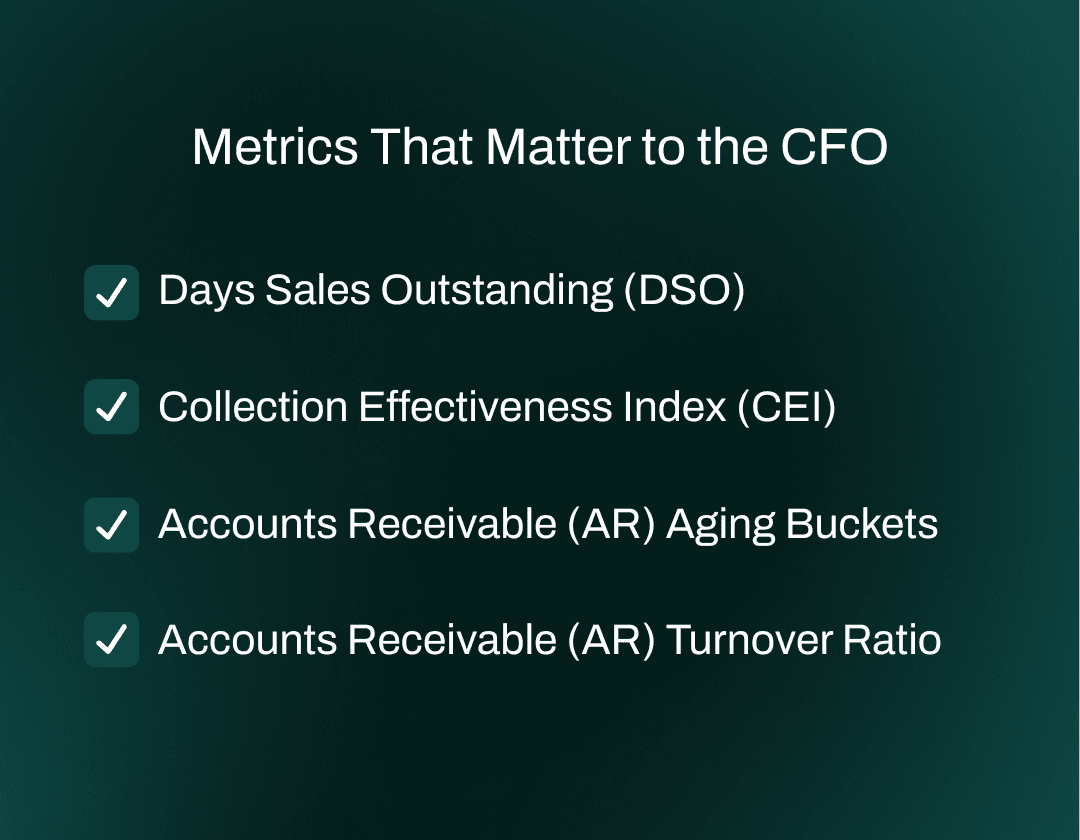
CFOs must move beyond transactional oversight to data-driven management of receivables. Key KPIs include:
Days Sales Outstanding (DSO) – measuring the average payment collection speed. More details about DSO.
Collection Effectiveness Index (CEI) – evaluating how much of receivables are collected during a given period.
Accounts Receivable (AR) Aging Buckets – highlighting delinquency trends.
Accounts Receivable (AR) Turnover Ratio – tracking efficiency of collections relative to sales.
Analyzing AR data helps leaders pinpoint where risks concentrate, enabling sharper prioritization and intervention. Other metrics to consider can be found in further detail in our Financial Efficiency KPIs for CFOs blog.
Cross-Functional Collaboration
Effective AR management isn’t owned solely by finance. Collaboration with sales and customer service can accelerate resolution of disputes, align customer experience with payment practices, and prevent issues before they reach collections.
Establishing visibility across departments by embedding AR dashboards within ERP and CRM systems allows finance leaders to track progress against shared KPIs, increase accountability, and align operational actions with financial strategy. Advanced analytics and automation workflows also help surface trends or bottlenecks early, allowing you to guide teams toward quicker resolution and improved customer relationships.
Fostering this cross-functional alignment ensures AR supports commercial strategy.
Continuous Improvement: From Reactive to Proactive
Accounts receivable must be managed as a living process. Continuous monitoring and refinement of policies, terms, and workflows ensure receivables remain aligned with evolving customer behavior and market dynamics.
From Gynger’s perspective, integrating automation and embedded financing into AR operations can further streamline this continuous improvement process, enabling CFOs to reduce administrative overhead while maintaining visibility and predictability in cash flow. This approach also provides actionable insights that inform policy adjustments, credit management, and customer engagement strategies.
Data supports the value of optimization: standardized accounts receivable workflows can reduce DSO by three days, improve dispute resolution by 59%, and free up to 30% of working capital (Auxis).
Strategic Capital Management: Unlocking Accounts Receivable for Growth
Even with best practices in place, accounts receivable often represents trapped liquidity, cash earned but inaccessible until customers pay. This creates a fundamental challenge: balancing growth initiatives against payment cycles.
This is where AR financing becomes strategic. By converting receivables into immediate working capital, you can:
Bridge timing gaps in cash flow
Fund investments in growth, innovation, or acquisitions
Reduce reliance on costlier forms of debt
Gynger’s approach enables CFOs to unlock capital tied up in accounts receivable, transforming it from a cash flow bottleneck into a growth enabler. By integrating AR financing into liquidity planning, CFOs can maintain a strong balance sheet while still fueling expansion. Gynger’s platform also highlights how automation can simplify receivable management while ensuring transparency and predictability across the finance function.
Turning Accounts Receivable into a Strategic Asset
Strong accounts receivable practices combine discipline, automation, visibility, and financing strategy. This means implementing not only the technical processes but also embedding a strategic mindset where AR directly supports business objectives:
Clear terms and credit policies that reduce risk while enabling customer relationships to thrive
Efficient invoicing and proactive collection cycles that minimize delays and strengthen cash flow predictability
Automation that frees resources, reduces manual errors, and integrates insights into decision-making
Data-driven KPIs that provide actionable intelligence for cash flow management and strategic planning
Strategic financing options, including AR financing, to unlock growth capital and optimize working capital allocation
Leveraging automation and embedded financing is central to turning accounts receivable into a strategic lever. By combining operational efficiency with capital access, CFOs can proactively manage receivables, maintain liquidity, and focus on initiatives that drive business expansion.
Accounts receivable best practices are therefore about more than routine management, they are about empowering you to use receivables as a strategic tool to support growth, optimize cash flow, and enhance financial resilience.
To learn more about how accounts receivable financing and automation can transform your receivables, explore Gynger’s AR solutions.
Join our newsletter to get monthly insights and updates
Next up


FAQ
Frequently Asked Questions
What is a credit program?
It's the option for your customers to pay over time, offered under your own brand. You get paid upfront, your customer pays in installments, and Gynger runs the financing behind it.